Fimavyn Guides: Ingredient Research and Smart Supplement Buying

Written by the GoFimavyn editorial desk
Last updated · Who reviewed this page · How we write and review
The Fimavyn guides include a metabolic support guide on what ten common ingredients were studied for, and a buyer's checklist for any metabolic supplement. Three journal posts cover berberine at 100 mg, green tea extract and the liver, and marketing red flags. A glossary explains eleven research and label terms.
Which Fimavyn guides cover the big questions?
Two long-form Fimavyn guides cover the questions readers ask most. One explains the research on common metabolic ingredients, and the other is a step-by-step buyer's checklist.
Both are free, dated and linked to their sources. Neither asks you to buy anything.
What do the three Fimavyn journal posts explain?
The Fimavyn journal posts each take one narrow question and answer it in full. They cover berberine doses, green tea extract and the liver, and red flags in supplement marketing.
Each post names the dose behind every study it quotes.
Berberine at 100 mg vs Study Doses
How a 100 mg berberine line compares with the gram-level doses used in diabetes trials.
Green Tea Extract and Your Liver
Why extract pills, not cups of tea, show up in liver case reports, and where the EGCG line sits.
Metabolism Supplement Red Flags
Drug-like promises, paid review pages and other signs that a pitch has outrun the evidence.
Newer posts appear first on the journal page.
Which Fimavyn read answers your question?
Find your question in the left column, then open the read on the right. If two rows fit, start with the guide.
| Your question | Start here |
|---|---|
| What was berberine, chromium or banaba studied for? | Metabolic support guide |
| Which ingredients can clash with my medicines? | Metabolic support guide |
| What should a label show before I trust it? | Buyer's checklist guide |
| What should I ask a seller before I pay? | Buyer's checklist guide |
| Is 100 mg of berberine enough to matter? | Journal: berberine at 100 mg |
| Could a green tea pill harm my liver? | Journal: green tea extract and the liver |
| Is this ad or review page trustworthy? | Journal: red flags |
In what order should you read the Fimavyn guides?
Read them from general to specific. Most readers get the most from the Fimavyn guides in four stages.
- First
Learn the ingredients
The metabolic support guide shows what each one was tested for, and at what dose.
- Second
Look at your own health
Write down your medicines and conditions. Several ingredients add to blood-sugar drugs.
- Third
Run the checklist
Use the buyer's checklist on any label you are weighing, including this one.
- Last
Go deeper where you need to
Open the journal post that matches your biggest doubt.
How do the Fimavyn guides judge a study?
The Fimavyn guides ask the same five questions of every study. Each answer changes how much weight that study gets.
NIH reviewers say most weight-loss supplement ingredients show small effects at best (NIH ODS, n.d.). The guides carry that verdict through, even where it touches this label.
- 1
Who was studied?
People with type 2 diabetes respond differently from healthy adults.
- 2
What dose?
The daily amount is set next to the label amount.
- 3
For how long?
Two weeks shows less than six months.
- 4
How big was the change?
A kilogram over months is small, even if it beats placebo.
- 5
How strong was the design?
Pooled, placebo-controlled trials count for more than one small study.
Where do the Fimavyn guides get their facts?
Every Fimavyn guide draws on three kinds of source. Product facts come from the bottle label, research comes from public health agencies and peer-reviewed reviews, and seller terms come from the sales page.
When a fact was never released, the guides write “not published” rather than fill the gap with a guess.
Serving size, every printed amount, the cautions and the distributor line.
NIH, NCCIH, FDA and EFSA pages for doses, safety signals and the rules on claims.
Cochrane and other systematic reviews, each with the dose and number of people noted.
Gaps that still stand include the four herb amounts in the blend, an independent lab report and any trial of the finished capsule. The editorial policy sets out how pages are written and corrected.
Each guide shows its Last updated date under the title. The most recent full check of both guides finished on October 12, 2026.
Fimavyn research glossary: eleven terms in plain words
The Fimavyn glossary explains terms from the studies and from the label. The right column shows where each one appears.
| Term | Plain meaning | Where you meet it |
|---|---|---|
| Randomized controlled trial | People are split by chance into a supplement group and a comparison group. | The strongest single-study design for a supplement |
| Placebo | A look-alike pill with no active ingredient. | Lets researchers separate a real effect from hope |
| Systematic review | A search for every trial on one question, judged by set rules. | Most sources in the guides are reviews like this |
| Meta-analysis | Many trial results pooled into one number. | Example: about 0.5 kg for chromium |
| Fasting glucose | Blood sugar measured after a night without food, often in mmol/L. | Berberine lowered it by about 0.59 mmol/L in type 2 diabetes |
| HbA1c | A blood test that reflects two to three months of average blood sugar. | Resveratrol did not change it |
| 200:1 extract | 200 parts of raw plant were used for 1 part of extract. | The resveratrol line on the label |
| Heat units (H.U.) | A measure of how hot a pepper is. | Cayenne at 40,000 H.U. in the blend |
| Ginsenosides | The marker compounds measured in ginseng. | Asian ginseng at 8% ginsenosides |
| Corosolic acid | The marker compound measured in banaba leaf. | Banaba extract at 2% corosolic acid |
| Silymarin | The group of compounds measured in milk thistle seed. | Milk thistle extract at 80% silymarin |
Which Fimavyn label numbers do the guides keep coming back to?
Four Fimavyn numbers come up again and again: 100 mg of berberine HCl, 150 mg of alpha lipoic acid, 100 mcg of chromium and the 112 mg blend. Each one sits next to a research range in the guides.
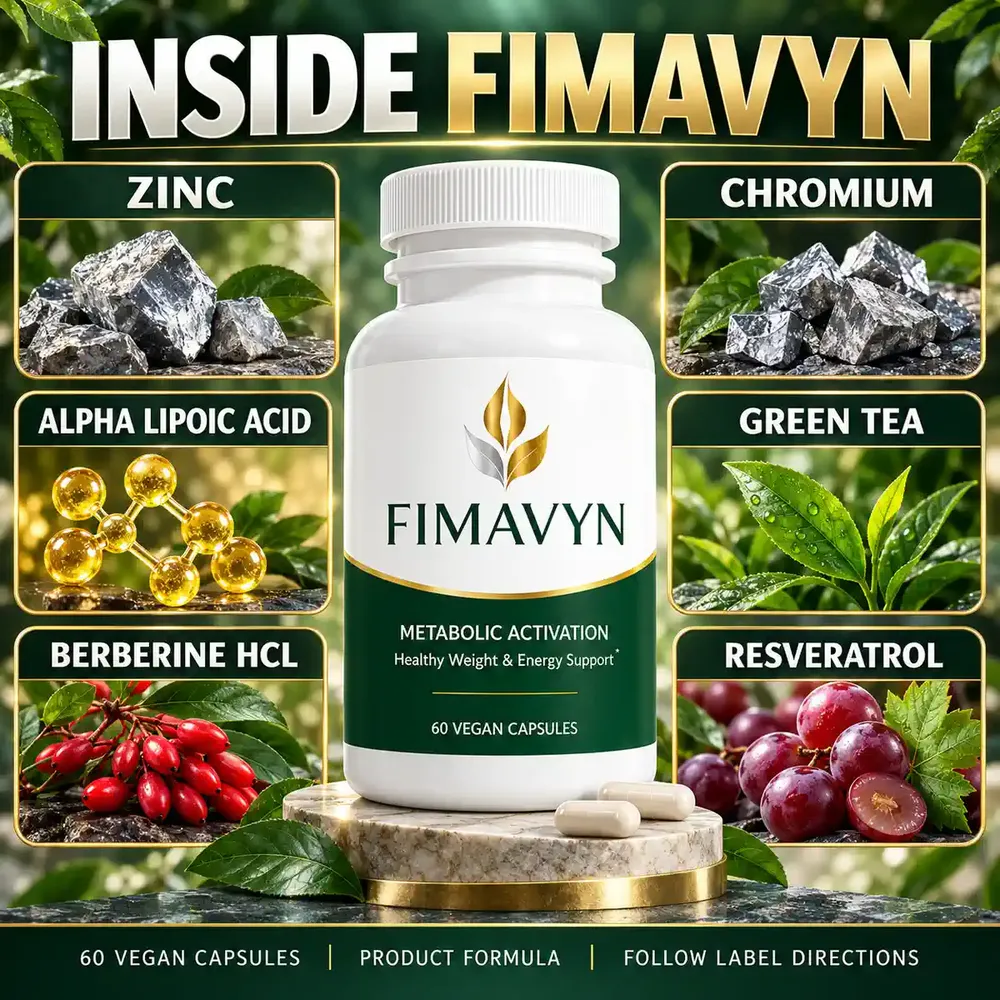
- Berberine: about 97 mg, next to 900-1,500 mg in most trials
- Alpha lipoic acid: 150 mg, next to 600-1,800 mg
- Chromium: 100 mcg, just under 137-1,000 mcg
- Blend: 112 mg for four herbs, no single amounts
The ingredients page turns these into a dose meter.
What will the Fimavyn guides never tell you?
The Fimavyn guides never promise a result. They stick to what the sources support, so some popular claims never appear.
- A number of pounds or a waist size you will lose
- That a capsule lowers blood sugar or burns fat
- That any supplement can replace diabetes care
- A timeline the maker never published
About the Fimavyn guides
Questions people type into Google and Bing, answered from the label and the sources on this page.
Is there a right order for reading the Fimavyn guides?
Yes. Read the metabolic support guide first, because it explains what each ingredient was studied for. The buyer's checklist then makes more sense, and the journal posts go deeper on single topics.
Do the Fimavyn guides cost anything or need an email?
No. Every guide and journal post is free and open, with no sign-up form or paywall.
What is a meta-analysis?
It is a study that pools the results of many earlier trials into one estimate. A larger pool gives a steadier answer, but weak trials still produce a weak result.
What does HbA1c measure?
It reflects average blood sugar over roughly the past two to three months. Diabetes trials often report it next to fasting glucose.
What is a Cochrane review?
It is a systematic review that follows strict published methods. The guides cite Cochrane reviews on chromium and green tea for weight (Tian et al., 2013) (Jurgens et al., 2012).
Why do the guides say a result was not significant?
A non-significant result means the difference from placebo was small enough to be chance. It is not proof of no effect, but it is not proof of an effect either.
Who checks the Fimavyn guides for medical accuracy?
Each guide ends with a reviewer box naming Dr. Fatima Cody Stanford, MD, MPH, MPA, who medically reviews the page for accuracy against the label and the cited sources. This is general information, not personal medical advice.
Can I suggest a new Fimavyn guide topic?
Yes. Email [email protected] with the question you want answered. Questions many readers send are written up first.
Do the Fimavyn guides tell me whether to buy?
No. They show the label, the research and the gaps side by side. The choice, and any medical question, stays with you and your doctor.