01Mineral
Zinc
11 mg
as Zinc Gluconate
What studies used
Daily need 8-11 mg; ceiling 40 mg
A basic mineral that meets the day's need. It is not there for weight. (NIH ODS, 2026)
Authorized American FIMAVYN outlet2 capsules a day · 60 per bottle
Minimum 60-day money-back guaranteeFree U.S. shipping on 3 & 6 bottles
Written by the GoFimavyn editorial desk
Last updated · Who reviewed this page · How we write and review
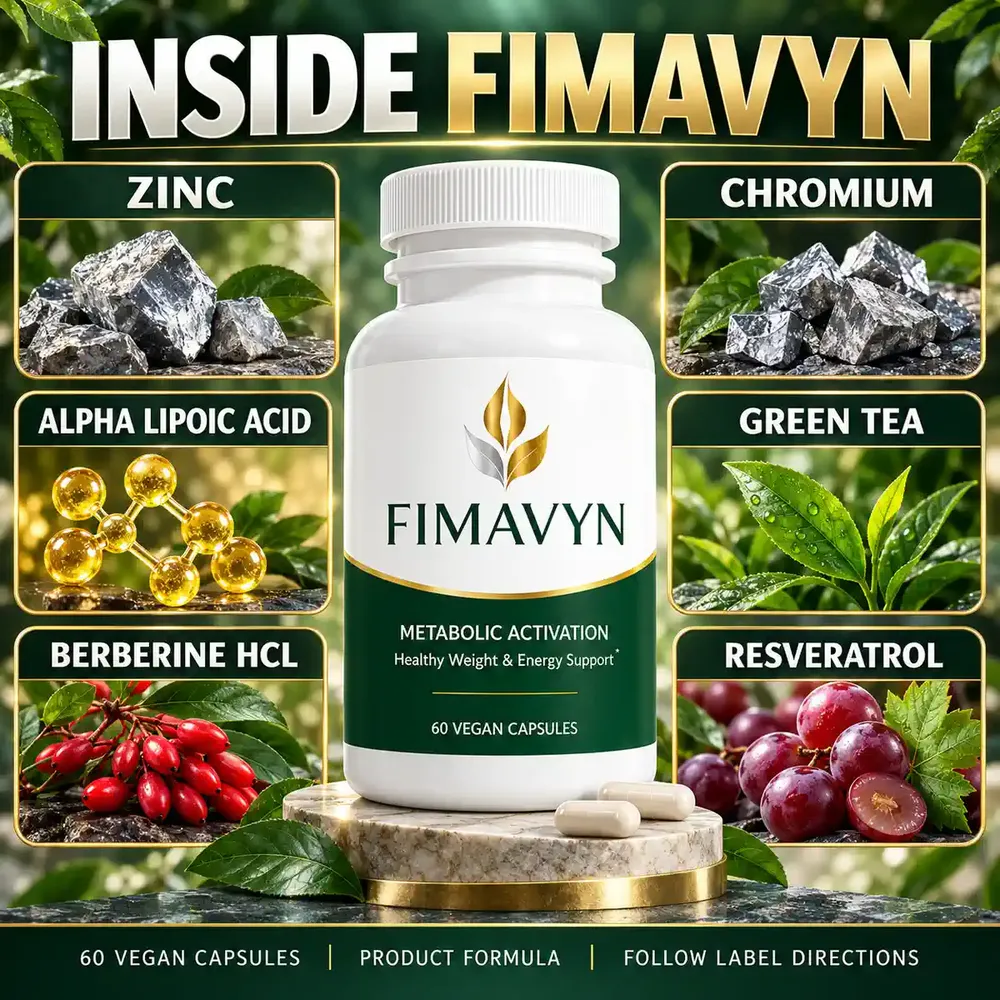
Fimavyn contains six listed nutrients and extracts plus a four-herb blend in every 2-capsule serving.
Per serving: zinc 11 mg, chromium 100 mcg, alpha lipoic acid 150 mg, green tea extract 150 mg (about 75 mg EGCG), berberine HCl 100 mg and resveratrol 40 mg. Milk thistle, cayenne, Asian ginseng and banaba share a 112 mg blend.
For the full panel with daily values, see the supplement facts.
Fimavyn lists seven ingredient lines per serving of 2 vegan capsules. Six are single actives with exact amounts, and the seventh is a 112 mg blend of four herbs, which makes ten named actives in all.
Tap or flip each card. The front shows the label amount, and the back shows the dose range human studies used, with the source.
11 mg
as Zinc Gluconate
What studies used
Daily need 8-11 mg; ceiling 40 mg
A basic mineral that meets the day's need. It is not there for weight. (NIH ODS, 2026)
100 mcg
as Chromium Picolinate
What studies used
Weight reviews: 137-1,000 mcg a day
Pooled trials showed small glucose shifts and well under one kilo of extra weight loss. (NIH ODS, n.d.)
150 mg
antioxidant fatty-acid compound
What studies used
Studies: 600-1,800 mg a day
Linked to better glucose use; it can stack with diabetes medicine. (LPI, n.d.)
150 mg
Camellia sinensis; 98% polyphenols, 80% catechins, 50% EGCG
What studies used
Trials: 141-1,207 mg catechins
Weight change was tiny and not significant; extracts carry a rare liver risk. (Jurgens et al., 2012)
100 mg
from Berberis aristata root, 97% berberine
What studies used
Trials: mostly 0.9-1.5 g a day
Fasting glucose fell in type 2 diabetes trials. Avoid in pregnancy; it meets many drugs. (Wang et al., 2024)
40 mg
from Polygonum cuspidatum root extract 200:1
What studies used
Glucose moved only at 100 mg+
Tested in type 2 diabetes rather than weight; big doses may add to blood thinners. (Zhu et al., 2017)
112 mg total
Milk Thistle seed extract (80% silymarin), Cayenne fruit (40,000 H.U.), Asian Ginseng aerial parts (8% ginsenosides), Banaba leaf extract (2% corosolic acid)
What studies used
No single amounts printed
Four herbs split 112 mg in unknown shares, so none can be checked against a study. (NCCIH, n.d.)
Fimavyn delivers about 97 mg of berberine a day. The label lists 100 mg of berberine HCl from Berberis aristata root, standardized to 97% berberine.
One review pooled 50 berberine trials in type 2 diabetes. Doses of mostly 900 to 1,500 mg a day lowered fasting glucose by about 0.59 mmol/L (Wang et al., 2024). The Fimavyn amount is close to one tenth of that range.
We compare the 100 mg dose with each trial in our article on berberine 100 mg versus study doses.
The 150 mg green tea leaf extract in Fimavyn works out to about 147 mg of polyphenols, 120 mg of catechins and 75 mg of EGCG. Each figure is 150 mg times the label percent.
EGCG is the catechin most linked to green tea research. Its weight effect in trials was small and not significant (Jurgens et al., 2012).
Supplements at 800 mg of EGCG a day or more raised liver enzymes (EFSA, 2018), so 75 mg is far below that mark. Green tea extract is still a rare cause of liver injury (LiverTox, 2020). The label does not say how much caffeine the extract keeps.
Read more in green tea extract and your liver.
These three cover the mineral and antioxidant side of the Fimavyn formula. Chromium and alpha lipoic acid are linked to how the body uses glucose, and zinc is a basic daily nutrient.
286% of the Daily Value, as chromium picolinate. Reviews found only slight glucose changes and about 0.75 kg of weight loss (NIH ODS, n.d.).
100% of the Daily Value, as zinc gluconate. That meets the adult RDA and stays well under the 40 mg upper limit (NIH ODS, 2026).
May help the body use glucose (LPI, n.d.). A meta-analysis tied it to about 1.27 kg of short-term weight loss (Kucukgoncu et al., 2017).
The Fimavyn blend holds milk thistle, cayenne, Asian ginseng and banaba in 112 mg total. The label prints each herb's standard but not its weight.
You know what is there, but not how much of each herb sits in your two capsules.
| Herb | Standard on the label | What human research looked at | Source |
|---|---|---|---|
| Milk thistle | Seed extract, 80% silymarin | Blood sugar in type 2 diabetes; evidence limited | (NCCIH, n.d.) |
| Cayenne | Fruit, 40,000 heat units | Calories eaten at the next meal; weight not measured | (Whiting et al., 2014) |
| Asian ginseng | Aerial parts, 8% ginsenosides | Blood sugar; results inconclusive | (NCCIH, n.d.) |
| Banaba | Leaf extract, 2% corosolic acid | Blood glucose; a few small 2-week studies | (Miura et al., 2012) |
Zinc meets its daily target, but most other Fimavyn amounts sit below the doses used in human studies. Berberine, alpha lipoic acid and chromium show the clearest gaps.
The meter uses a log scale, so each step to the right is ten times larger. The dot is the label amount, and the band is the study range.
The 11 mg line covers a full day's zinc need, with plenty of room under the 40 mg ceiling. Sources: (NIH ODS, 2026)
Just under the lowest studied amount; even full doses moved weight by roughly half a kilo to a kilo. Sources: (Onakpoya et al., 2013) (Tian et al., 2013)
One quarter of the smallest study dose. Sources: (LPI, n.d.) (Kucukgoncu et al., 2017)
Roughly 120 mg catechins and 75 mg EGCG by our math, a tenth of the 800 mg EGCG level linked to liver enzyme rises. Sources: (Jurgens et al., 2012) (EFSA, 2018)
About 97 mg after the 97% purity, close to one tenth of a typical trial day. Sources: (Wang et al., 2024) (Dong et al., 2012)
40 mg sits in the low-dose group where fasting glucose did not change. Sources: (Zhu et al., 2017) (LPI, n.d.)
Its share of the 112 mg blend is not printed, so no comparison is possible. Sources: (Whiting et al., 2014)
Blend share not printed; the human studies behind it were small and brief. Sources: (Miura et al., 2012)
Fimavyn amount dose range used in human studies (log scale)
For how these ingredients are meant to fit together, see how Fimavyn is designed to work.
Fimavyn lists three other ingredients: microcrystalline cellulose, magnesium stearate and silica. They help fill the capsule and keep the powder flowing, and they are not actives.
The label calls the capsules vegan. It does not say gluten-free, and it lists no caffeine line.
Every line as it appears on the bottle is on the Fimavyn supplement facts page, and safety notes for each ingredient are on Fimavyn side effects.
Questions people type into Google and Bing, answered from the label and the sources on this page.
Per 2 capsules: zinc 11 mg, chromium 100 mcg, alpha lipoic acid 150 mg, green tea extract 150 mg, berberine HCl 100 mg, resveratrol 40 mg and a 112 mg herbal blend.
About 97 mg a day, from 100 mg of berberine HCl at 97%. Most diabetes trials used 900 to 1,500 mg (Wang et al., 2024).
Milk thistle, cayenne, Asian ginseng and banaba. The label gives only the blend total.
EGCG, the main green tea catechin, makes up half of the 150 mg extract. That is about 75 mg per serving.
Its corosolic acid has been studied for blood sugar in a few small, short trials (Miura et al., 2012). The Fimavyn amount is hidden in the blend.
No study shows that. In type 2 diabetes trials, glucose changed only at 100 mg a day or more (Zhu et al., 2017), and Fimavyn has 40 mg.
It is the chromium form named on the label. Reviews of it found about 1 kg of extra weight loss, on low-quality evidence (Tian et al., 2013).
Cayenne brings capsaicinoids. Taken before a meal, they cut about 74 calories at that meal in pooled trials (Whiting et al., 2014).
Its blood sugar evidence is inconclusive (NCCIH, n.d.). Fimavyn uses the aerial parts, the leaves and stems, at an unlisted amount.
Limited evidence suggests silymarin may help blood sugar in type 2 diabetes (NCCIH, n.d.). Its Fimavyn dose is not printed.