Fimavyn Green Tea Extract: How Much EGCG and What It Means for Your Liver
Written by the GoFimavyn editorial desk
Last updated · Who reviewed this page · How we write and review
Fimavyn lists 150 mg of green tea extract at 50 percent EGCG, about 75 mg of EGCG per serving. A European safety panel saw liver enzymes rise at 800 mg a day or more, roughly ten times higher. LiverTox calls extract liver injury rare and usually reversible after stopping, yet no dose is named as assured safe.
What do the EGCG numbers on the Fimavyn label mean?
They describe one 150 mg scoop of green tea leaf extract in three layers. The label says 98 percent polyphenols, 80 percent catechins and 50 percent EGCG, which works out to about 147 mg, 120 mg and 75 mg.
The layers nest like boxes. EGCG is one catechin, and catechins are one group of polyphenols. So the three numbers never add together.
| Layer | Label percent | Milligrams per serving | What it is |
|---|---|---|---|
| Green tea leaf extract | 100% | 150 mg | The whole extract line on the label |
| Polyphenols | 98% | About 147 mg | The broad family of plant compounds |
| Catechins | 80% | About 120 mg | A group inside the polyphenols |
| EGCG | 50% | About 75 mg | One catechin, named on the label |
The milligram figures are calculated, not printed. The label gives only the 150 mg total and the three percents.
How does Fimavyn's 75 mg of EGCG compare with the liver warning level?
It is about one tenth of it. A European food safety panel found that 800 mg of EGCG a day or more from supplements raised liver enzymes (EFSA, 2018).
Seventy-five milligrams is roughly 9 percent of that level. The same panel did not name any supplement dose as assured safe, so far below is not the same as risk-free.
The panel's warning level applies to EGCG taken as a supplement. Raised liver enzymes show up on a blood test, which is why the finding matters even when nobody reports symptoms.
How often does green tea extract harm the liver?
Rarely, but it is a known cause. The NIH LiverTox database calls green tea extract a well-established but rare cause of liver injury that usually resolves after stopping (LiverTox, 2020).
The case reports it describes involved roughly 1 to 1.86 g of extract a day. That is about 7 to 12 times the 150 mg of extract in one serving of Fimavyn.
| Source | Amount | What was seen |
|---|---|---|
| Fimavyn, one serving | 150 mg extract, about 75 mg EGCG | No study of the product |
| Weight trials (Cochrane) | 141-1,207 mg catechins a day | Small, non-significant weight change |
| European safety panel | 800 mg EGCG a day or more | Liver enzymes rose |
| LiverTox case reports | About 1-1.86 g extract a day | Rare liver injury, usually resolved after stopping |
Rare does not mean it can be ignored. It means most people never see it, and a few do, without a clear way to predict who.
Why are extract pills watched more closely than brewed tea?
Because the rare liver cases mostly involved pills. The NIH center for complementary health says liver damage has been reported mainly with green tea extract pills (NCCIH, n.d.).
An extract packs the active compounds into a small, dry dose. A capsule that is 98 percent polyphenols is concentrated by design.
The same NIH center reminds buyers that natural does not always mean safe (NCCIH, n.d.). A plant source tells you where an ingredient came from, not how it behaves in a concentrated dose.
- Brewed tea: a drink with a wide range of strengths
- Extract pill: a measured, concentrated dose
- Liver case reports: mainly linked to extract pills
Does Fimavyn's green tea extract do much for weight?
The research says not much. A Cochrane review of 18 trials with 1,945 people found a small weight loss that was not statistically significant (Jurgens et al., 2012).
Those trials used 141 to 1,207 mg of catechins a day for about 12 weeks. Fimavyn gives about 120 mg of catechins, just under the low end of that range.
An NIH fact sheet on weight-loss supplements reaches a similar view, rating green tea's effect as small and of doubtful clinical value (NIH ODS, n.d.). The Fimavyn label itself claims healthy weight and energy support, not weight loss.
Can EGCG from several products add up?
Yes, and it is the easiest way to drift toward high amounts. EGCG from a multivitamin, a fat-burner and a metabolism capsule all count toward the same daily total.
Taking extra capsules adds up the same way. Four servings of a product with 75 mg of EGCG would already reach about 300 mg.
Before you add a green tea product, check: 0 of 5 checked
How do you work out the EGCG on any supplement label?
Multiply the extract amount by its EGCG percent. If no percent is printed, the EGCG amount cannot be worked out at all.
- 1
Find the extract line
Look for green tea leaf extract or Camellia sinensis, with a milligram amount.
- 2
Find the EGCG percent
It may sit in small print after the plant name.
- 3
Multiply
150 mg at 50 percent EGCG gives 75 mg, the Fimavyn figure.
- 4
Compare with 800 mg
Set your total next to the level that raised liver enzymes.
- 5
Note what is missing
Check whether caffeine is listed. On some labels it is not.
Fimavyn passes the first three steps, since every percent is printed. It does not state caffeine, so that number stays unknown.
Who should talk to a doctor before taking Fimavyn's green tea extract?
Anyone with a liver condition, and anyone on daily medicine. The Fimavyn label asks people who take medication or have a medical condition to consult a physician first.
The label also rules out anyone under 18 and women who are pregnant or nursing.
The Fimavyn side effects page covers the other label ingredients, including berberine and the blood-sugar points.
Where does green tea fit in the rest of the Fimavyn formula?
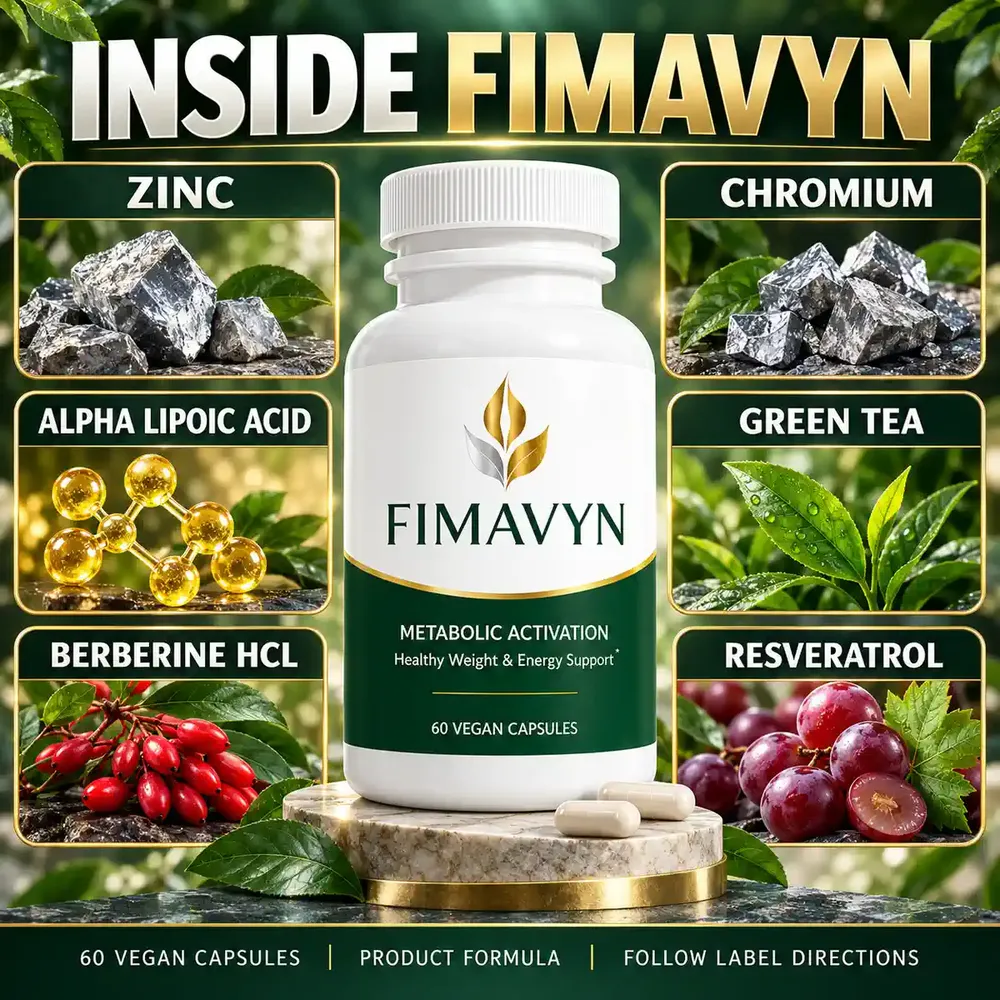
It is one of seven label lines, alongside zinc, chromium, alpha lipoic acid, berberine, resveratrol and a four-herb blend. Milk thistle is in that blend, but the label does not say how much, and NCCIH rates its evidence as limited (NCCIH, n.d.).
The Fimavyn ingredients page compares each line with its research range. Our post on berberine at 100 mg runs the same math for the berberine line.
If a modest, clearly printed EGCG amount is what you want, the pricing page lays out the 1, 3 and 6-bottle packs, with prices shown at checkout. Keep to two capsules a day.
Green tea extract and the liver: questions people ask
Questions people type into Google and Bing, answered from the label and the sources on this page.
How much EGCG is in a serving of Fimavyn?
About 75 mg. The label lists 150 mg of green tea leaf extract standardized to 50 percent EGCG, and half of 150 mg is 75 mg. The label does not print the EGCG amount itself, so this is worked out.
Do the 98%, 80% and 50% figures add up?
No, they nest inside each other. EGCG is one of the catechins, and catechins are a kind of polyphenol. All three percents describe the same 150 mg of extract.
How much EGCG a day is too much?
A European safety panel found that 800 mg of EGCG a day or more from supplements raised liver enzymes. The panel named no supplement dose as assured safe.
How rare is liver injury from green tea extract?
Rare, but real. The NIH LiverTox database calls green tea extract a well-established but rare cause of liver injury.
Does liver injury from green tea extract go away?
LiverTox says it usually resolves after the extract is stopped. Anyone who feels unwell while taking it should stop and call a doctor.
Is brewed green tea the same as an extract pill for the liver?
Not in the safety record. NCCIH says the rare cases of liver damage were reported mainly with green tea extract pills.
Is there caffeine in the green tea extract in Fimavyn?
The label does not say. The extract is standardized for polyphenols, catechins and EGCG, and Fimavyn lists no caffeine line.
Does green tea extract help with weight loss?
Not by much. A Cochrane review of 18 trials found a small weight loss that was not statistically significant and unlikely to matter clinically.
Can I take Fimavyn with another green tea supplement?
Ask your doctor first. EGCG from every product you take adds up, and the label says not to exceed the recommended dose.
Should someone with a liver condition take green tea extract?
Talk to a doctor before starting. The Fimavyn label asks anyone with a medical condition or on medication to consult a physician first.
Does Fimavyn contain EGCG?
Yes. Fimavyn lists 150 mg of green tea extract at 50 percent EGCG, which works out to about 75 mg of EGCG per serving. Check other supplements you take, since EGCG can add up across products.
Is Fimavyn green tea extract safe for the liver?
The 75 mg of EGCG per serving is well below the 800 mg a day level where a European safety panel saw liver enzymes rise. Anyone with a liver condition should ask a doctor before taking it.